Dear Cactuseaters blog readers: I know some of you still check this! I just wanted to let you know that my brand-new interactive fully functional website launches on Monday. So from now on, all announcements, news, links, etc. So if you are looking for updates, news and links to writings, kindly turn your attention to http://danwhitebooks.com
I know I've been talking about getting an actual website for a long while and I've procrastinated for seven years and running. But now it's finally here and I think you'll agree it was worth the wait. The designer, Jason Liebman, did a marvelous job. The design elements for the site were directly inspired by David Shoemaker, who designed the cover for my new book, Under The Stars, which comes out on June 14.
The new site will also give you up-to-date announcements of readings and other events, and will soon include links to other writings.
And thank you all so much for writing in over the past few years. I really appreciate it. See you all in my brand-new site next week.
Saturday, May 14, 2016

Tuesday, May 10, 2016
Unless something truly terrible happens to you when you go camping ...
... then surely you will look back on whatever happens to you and laugh about it long and hard. For instance, last weekend, when I went camping on Mother's Day, I set up an impermeable tarp beneath our tent, then a rainstorm came down, the water pooled in the tarp beneath our tent, and we all got flooded out! On the good side, this is one Mother's Day that I will not soon forget. It will be etched in my memory forever. That's one of the great things about sleeping under the stars. The memories remain in your head forever, and yet our recollections of discomfort and rushing around, bailing out our families and draping our rain-soaked undies on an oak bough to dry, tend to mellow out over time, like certain bottles of Bigfoot Barleywine. I look forward to getting out on the book trail, meeting you all, and hearing your camping highlights and horror stories. I think you all know by now that camping contains the full range of human experience, from ecstasy to confusion and chilblains.
.....
.....
Friday, April 22, 2016
My upcoming book, Under The Stars, featured in Publishers Weekly and Huffington Post
My latest news is that Publisher's Weekly ran a great review of Under The Stars that summed up the book far better than I could, being much too close to the material to sum it up in such an elegant way. And I just found out that the Huffington Post included Under The Stars in its list of six books that make Earth Day every day. And this just in: I found out that my Under The Stars book tour launch is going to take place at Bookshop Santa Cruz, right here in my hometown, on June 20. And please stay tuned for more updates. The official release date of the book is June 20. It will be available as a hardcover book (with my own illustrations) and also as an audiobook. It will, of course, also be available as an ebook.
Thursday, March 03, 2016
Some news about the new book
hi everyone. Thanks for checking in again, and please forgive me for taking so long to respond to the messages that several of you left for me on Facebook. I didn't realize that Facebook had been filtering my messages, and when I checked it recently, I discovered that there were Cactus Eaters related messages in there that had been hanging around unread since 2014! I just wanted to let you know that Under The Stars will be available June 14 in hardback and e-book form, but it will also be coming your way very soon as an audio-book. Last week I had the exciting and surreal experience of choosing the voice actor who is going to 'play' me in the audio version. In other news, I'm also very glad to report that several writers (including some whose books I have been reading for a very long while) have already read and praised the upcoming book, among them, the fiction writer Elizabeth McKenzie and the environmental writer Bill McKibben. Scroll down and you'll find their remarks. Looking forward to sharing this with all of you in mid-June. I am going out on the road with Under the Stars in summer and will let you know when I have some dates in place.
Friday, January 15, 2016
Web address, domain name for upcoming website
Hi everyone. The landing page is here, and the website will be called Danwhitebooks.com
Stay tuned. It is currently under construction.
Stay tuned. It is currently under construction.
A podcast of sorts about my new book, Under The Stars: How America Fell In Love With Camping
As a kind of warm-up for future readings, here is my very first podcast (of sorts) in which I talk briefly about my new book and describe a few of the insane situations that took place while I was researching it. (After you click on the above link, scroll down the page a bit and you'll see the little 'play' button.)
Tuesday, December 08, 2015
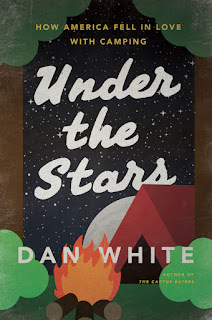
A proper website is coming soon -- seriously. And here is the cover for my brand-new book, coming your way soon.
I know I've said this before and then not gone ahead with this, but a much nicer looking author's landing page (I mean that the page itself will be nicer looking, not the author himself) will be coming your way pretty soon. And my latest book is now done and coming your way in June. Here is the cover:

Wednesday, October 21, 2015
(In)frequently asked questions regarding The Cactus Eaters
The Cactus Eaters frequently asked questions
First of all, I thank you for being curious enough about TCE to take a look at this.
I'm putting this up there because I'm just about finished with updating this blog as i contemplate a website supporting my new book. So I might as well let this just linger up here on the blog for a while because new people keep checking up on this. This has been updated slightly. I should tell you right now that this contains some spoilers so stop reading right here if you haven't finished the book. Every once in a while, I go in here and change the wording when I notice something clunky, unfinished, inflammatory, etc. Anyway, this wraps up my work on this blog. Thank you all for keeping the first book in print; I really appreciate that!
What are you working on now?
My book is now finished and turned in to the publisher and ready to go. It will be coming your way in June of 2016. It's called Under The Stars. It's an intimate look at the history of American camping, starting with the ever-controversial Henry David Thoreau and continuing into the era of survivalist camping and glamping. I put my all into this book, whether I was piloting a gigantic motorhome across the Southwestern desert or attempting to survive naked in the Santa Cruz Mountains. I am a character in this book, but only in a way that serves the subject. The "memoir" aspects are the connective tissue for the most part. Often I'm in the background, or just serving as your master of ceremonies. There is a huge participatory journalism aspect of this book -- with me doing all these crazy things -- but in each of those circumstances, I'm trying to illustrate a particular period of time in American history. I've already read live from the book, at a Catamaran event in Santa Cruz and at a beauty salon in San Francisco as part of Litquake -- that was probably my best reading ever. I've been thrilled with reader and audience reactions so far.
Why name the book Cactus Eaters instead of Cactus Eater?
To be honest with you, that still seems like a placeholder title. I still keep thinking a better title will pop into my head! Who knows why I became fixated on that title. I guess I just liked the way it sounded. It's a big improvement over the original title, Magnets of Adversity, suggested to me by a former professor. The other proposed title was The Lois and Clark Expedition, but I thought that was too cutesy. But I am still on the fence about the title as it stands now. It sounds just a little bit New Age-y, like a Carlos Castaneda taking-peyote-in-the-desert revelation memoir.
Did you expect the book to be so polarizing? It seems to me -- from sifting through the reviews (and though it might sound like pure masochism, I have read every single review that has ever appeared about The Cactus Eaters) that about 60 percent of the readers really "got" the central, controlling joke behind that book - that I, the person who sat down and wrote it, am often standing back in judgment, and in shock, about the crazy obsessive person who walked the trail. In other words, they understand that there is a bit of a distance between my present-day self and the insane, hypo-manic "voice" that serves as the narrator for the book. I think everyone has done some silly, dopy things when they were younger -- and it would have been impossible to write the book if I didn't have a lot of distance between the older writer and the callow youth who was having the adventures.
What happened to Allison" from the Cactus Eaters?
I have to be extremely careful here considering we're talking about a private person with a life outside all this, but you've expressed so much curiosity that it's kind of forced my hand. I hope I'm not revealing too much by telling you this, but the last time I checked in, I found out that she had bagged the entire state of California on the PCT after coming back to the trail with a friend. That's a really remarkable feat. To be honest, she's doing much more long-distance backpacking than I've done in recent years and will ever to again for various reasons, though I'm really into camping right now. I can't really go into any more details because there hasn't been recent communication and I just don't want to intrude and be a busybody.
Has Wild and its phenomenal success caused people to find out about The Cactus Eaters?
I have no way of knowing if it does or does not. There is always this slow, steady trickle of readership of The Cactus Eaters, with people posting online review of it every single day, almost without fail, in one outlet or other according to my Google Alerts. But that has been going on from the very beginning. Is that because of word of mouth, and did the renewed interest in the trail sustain that? I have no way of knowing. My guess is that the very small but steady readership of the Cactus Eaters is self-sustaining, through book groups, chat boards, words of mouth etc. I, personally, have not lifted a finger to promote the book in quite a few years because I am overwhelmed by so many other responsibilities (one more book coming along, a third book roughed out and about half-finished, and a zillion other things.) It's weird. Usually with a book like this, there is a sifting process. But it's still taking place. Every month there are people who love it, and people who have over the top WTF reactions. I wish there was a way of funneling it directly into the hands of people who get it, rather than people that are going to become enraged about it. But life doesn't really work that way.
What else should I read about the PCT?
Well, you've all read Wild, right? So the next one on your list should now be Gail Storey's wonderful book, I Promise Not To Suffer. I was hooked the whole way through. It's funny, surprising, and sad, and it does something that few books can do: it gives you a vivid sense of what a good, healthy relationship actually looks like, what it requires from both partners, and how it works. I just sent Gail a note about all this but I want to make sure you know about it, too. Also, have you read Robyn Davidson's Tracks? Not a PCT book, (it involves a slog across the Australian Outback), and she has a team of nasty camels instead of thru-hikers walking with her, but you'll see that Davidson's journey has a lot in common with Strayed's and so many others. I haven't read Aspen Matis's new book yet but I hear it's great, and it's high on my list.
If I go on to the Pacific Crest Trail and return home, will I have a nervous breakdown? Look -- if you go on any adventure and then resume your normal life, there is bound to be some kind of letdown. Don't let that factor dissuade you from hiking on a national scenic trail!! Chances are you'll feel a little down in the dumps and antsy for a short while and then you'll get over it as you discover new adventures. Besides, fearing a letdown is not a reason to avoid doing something enjoyable. That's kind of like saying you won't drink a milkshake because you will get a slight stomach ache and brain freeze afterward. In other words, it's worth it.
Have you undertaken any adventures since the trail?
Yes -- a whole bunch for the new book. I don't want to spoil any surprises, though.
Would The Cactus Eaters have taken place if you'd been carrying a reliable GPS?
Most of the incidents would still have taken place but I don't think I would have gotten lost so much. The fact is, I took two recent trips -- one to Maine, with a GPS and extensive studies of the terrain, and pre-programmed coordinates, and another to the Kentucky backwoods for the NY Times -- no GPS at all, and only a foggy understanding of the terrain. I did great on the Maine trip, even though there was no map at all, and in some sections, no trail. The Kentucky trip was scary at times, but when it was over, some good people in Whitesburg, Kentucky, invited me to their house, and we stayed up most of the night drinking Bulleit Bourbon. So I bought a whole bunch of it and put it in my backpack and brought it home to California, only to realize that they stock the same bourbon at Trader Joe's.
What was the timeline of your hike?
I finished my PCT journey in the fall of 1994. The trail scenes all took place in 1993 and 1994. The book spans a 14-year period of my life, starting in 1993 in California (when the opening scene takes place) and coming to a close in the winter of 2007 in Manhattan. The post-trail Santa Cruz 'blue period' unfolds in 95 and 96. The book ends in 2007. A lot of the narrative hinges around the 1990s-- and that is very important for the book, mostly because there were no telecommunications devices at our disposal. It wasn't just the fact that we were greenhorns. We also had no cell phones, no way of calling out, and there was certainly no means of 'texting' anyone about what was going on. In a sense, it was extremely primitive compared to hiking these days. That definitely ramped up the adventure.
What has changed on the trail since you hiked it?
It's important to note that my experience was atypical, if not downright weird, for reasons that go beyond the year I did it, though that was certainly part of it. My trip was peculiar because we left too late and were not part of a large social group of hikers. This meant we ended up hooking up with fast-walking stragglers, who were bringing up the rear of the pack, and were probably quite a bit more eccentric and extreme than your everyday thru-hiker. As for the changes: There are more 'trail angel' networks and trail communities, and much better dissemination of updated trail information (up-to-the-moment trail conditions as well as recommended gear.) The upkeep and maintenance of the trail is much-improved. Trail advocates have gotten a lot more sophisticated and much better organized. The trail is a lot more visible, well publicized, and better managed these days. These days, it's easy to go on the net and get consumer information about the best and worst hiking gear. When I did the trail, I pretty much had to test out all that crap myself. There are (from what I hear) many more women hiking the trail, including solo-hikers (I know two of them, and one of them has a PCT book in the works.)
Why wait for more than a ten-year period before writing the book?
I didn't really wait. it just worked out that way. I could not see my way around the trail, or see the shape of the narrative, or, to be honest, see anything the least bit funny about the hike (!), until I waited for a long time.
I am hoping to publish my own trail narrative. Any advice?
Do everything you can to get your work out there -- blogging, newspaper columns, or anything else at your disposal. If you have an interesting story to tell, you're sure to find an appreciative audience. Write from the joy of creation and try -- at least early on in the process -- to not drive yourself nuts wondering about how people are going to react. Write to help you understand what you think. Don't rush the process, ever. Someone once said that art is not a potato-sack race. Also, don't be afraid to take risks in terms of style, structure, content. Read constantly, while seeking inspiration from unexpected sources. Personally I love photography and sculpture exhibits because they awaken a playful kind of creativity I can't find in literary sources.
Did you know you were going to write a book when you set off on the trail?
Yes and no. If I was serious about it in the beginning, I would have put specific dates on more of my journal entries (and not written the entries in such messy handwriting and all out of sequence, which made it annoyingly difficult for me when I dug up those scattered to some extent, rain-smeared journals more than 10 years after the fact.) I also would have done a better job of protecting my journals from the elements. About 25 percent of my journal entries were decimated by El Nino storms while sitting in a box in an outside shed in Pleasure Point, California. My landlord accidentally threw out lots of stuff from that shed, including my rolling resupply box. And, come to think of it, I would have gotten photo releases from everybody, too. That would have been a smart thing to do. Every once in a while, someone gripes about the lack of photos.
Read on, but only if you are planning to hike any major trail:
Are you thinking of a through-hike? Make sure to read up, make plans, get in shape and talk to as many PCT trail vets as you can. For starters, order the official guidebooks and at least skim them in advance, marking up the water stops, supply stops, etc. Get inspired. Hike yourself into the best physical shape you conceivably can before setting out. To fire yourself up, you've got a heap of top-notch books to choose from. I named a couple of them earlier in this posting, but I also liked Wanderlust by Rebecca Solnit (if you would like to read a beautiful, sweeping literary overview of pilgrimages on foot), Footsteps by Richard Holmes (in particular the section when he is tracing the footsteps of Robert Louis Stevenson in Europe) and my all-time-favorite fictional account of a long walk, To The End of the Land by the amazing David Grossman, about a mother trying to evade tragedy by walking through Israel.
The various experiential trail books and weblogs will give you some sense of what to expect. But, quite frankly, many of the published accounts are better for the sake of pure inspiration and entertainment than for actual trail preparation, simply because the trail is so wide open. Any two people are bound to have vastly different experiences. I've heard a couple of people describe my book as a "guidebook,'' and that's asking for trouble. The memoirs aren't supposed to be trail guidebooks. If you're really trying to get the most up to date picture of what is going on right now, there are countless weblogs now available, as well as informational clearinghouses on lightpacking that you can find on the web.
Of course, you will get updated information from official as well as unofficial PCT sites maintained and updated by enthusiasts. I recommend both Jardine books because they were the 'starting gun' for the lightpacking movement --- but there are countless lightpacking blogs and websites to choose from these days.
Choose your gear wisely. Don't go for flashy brands. Find out what successful through-hikers have used in the past, especially when it comes to stoves and water filters, two devices that can make your life a living hell out there if they are difficult to use or poorly manufactured. (I love my old warhorse Katadyn -- not kidding when I tell you that it can filter liquid mud into potable water, no problem!!! - but I'm not sure if they make my old-school 'pocket filter' anymore.) Find out about sewing your own lightweight packs from a kit if you're handy with a needle and thread. Ask a recent through hiker to share his or her itinerary and list of contacts (good cheapo restaurants, local 'trail angels' and the like.) In almost all cases, they will be more than happy to share their schedules. Do long prep hikes to determine your pace. Also, it would be a great idea to take an orienteering course taught by an experienced, savvy leader. Don't set unrealistic expectations for your MPD (mileage per day.) Find a comfortable pace and learn to stick with it. And whatever you do, don't make big batches of home-made granola. The nuts will spoil, and you will find yourself throwing that stuff away in the trash can or leaving it in the 'freebie' box at a trail stop. I hope that answers your question.
And, since we're on the subject of reliable trail information ...
Here is one of the most comprehensive Web clearinghouses I've found for PCT links, planning forums, PCT trail logs and the like.
Also, make sure to check out this inspiring site if you are either thinking of doing the trail or are interested in trail lore (or other trails.)
And here's some stuff about the Continental Divide Trail:
I just finished "hiking" it vicariously; Lawton "Disco" Grinter sent me his inspiring videographic memoir of his CDT adventures.
And finally, here is the clip-and-save Thank You's and Acknowledgments section for the Cactus Eaters
The "thank you" and "acknowledgment" section of my book was amended and updated two and a half years ago because it was overly long and woefully incomplete. Thank you to everyone who helped out with my book, The Cactus Eaters. My wife, Amy Ettinger, worked hard in NYC (her employers, among other people, included the Metropolitan Museum of Art) so I had time to finish the project while holding down a 20-hour-a-week teaching load. She is the one who shlepped out to all those book readings and events, and dealt with the ups and downs of this from the beginning. Without her, there would be no book at all, period, end of story.
Thanks to my advisor Patricia O'Toole, to Michael Scammell, Lesley Sharpe, and the students in the nonfiction workshop.
Thanks to all the folks who inspired the work. A big thank you in particular to "Allison," and not just for being such an essential and good-humored part of the crazy journey, keeping a clear head and persevering on the trek itself (and choosing the PCT as the L&CE's expedition of choice, after considering several other options, including the AT and the Camino de Santiago). Allison also read and reviewed a number of my emails in regard to several essential scenes, most notably the cactus-biting incident, which was, as it turns out, even more perverse and horrible than I even remembered. Allison's feedback was incorporated into the section involving a tick attack (which was also worse than I remembered). In case you are wondering, Allison is doing very well. That's really all I can say about that for now.
Thanks to Mark the Postman, too. You saved me, big time, when you convinced me to throw all that junk out of my pack and send it home. Without you, I would have collapsed from heat prostration for sure. Sorry I couldn't figure out how to reach you and thank you before the book came out. I was relieved to hear you liked the book.
A rough draft of this book was completed in 1996 (I am not kidding. In some sense, the Cactus Eaters actually predates a certain other, much-talked about book about a different trail), but it sucked, severely, so I threw it away completely. The book began to take shape again around 2003-4 or so, when I drafted up a few lengthy emails and started to 'grow' them into a manuscript. Without the help of the Cheese Wheel Book Group, consisting of Vito Victor, Elizabeth McKenzie, Richard Huffman, Richard Lange and John Chandler, that task would have been impossible.
My sister, Edie Achertman, and brother-in-law Doug Achterman, and my pal Dave Howard, all contributed feedback and advice. So did my mother-in-law, Sheila Ettinger. Thanks to my parents about being good sports about the "Grampa Gappy" stuff, etc, and to my brothers Phil White and the late David Gordon White, (1965-2009) whose own writings and songs were always a huge influence on me.
Finally, I taught quite a bit of undergraduate essay writing, fiction, nonfiction and poetry while working on this thing. That experience really helped with the writing process, so I'm grateful to all the students (and so far, I've had about 300 of them, if you can believe that ...)
That's all for now .... Thanks for checking in every once in a while. I like hearing about all the places where the book turns up (including a hostel in India, and, from what I hear, all across Australia.) If you come across a copy of the book in an extremely far flung location, let me know. Even better, send me a JPG photo.
Peace,
DW
First of all, I thank you for being curious enough about TCE to take a look at this.
I'm putting this up there because I'm just about finished with updating this blog as i contemplate a website supporting my new book. So I might as well let this just linger up here on the blog for a while because new people keep checking up on this. This has been updated slightly. I should tell you right now that this contains some spoilers so stop reading right here if you haven't finished the book. Every once in a while, I go in here and change the wording when I notice something clunky, unfinished, inflammatory, etc. Anyway, this wraps up my work on this blog. Thank you all for keeping the first book in print; I really appreciate that!
What are you working on now?
My book is now finished and turned in to the publisher and ready to go. It will be coming your way in June of 2016. It's called Under The Stars. It's an intimate look at the history of American camping, starting with the ever-controversial Henry David Thoreau and continuing into the era of survivalist camping and glamping. I put my all into this book, whether I was piloting a gigantic motorhome across the Southwestern desert or attempting to survive naked in the Santa Cruz Mountains. I am a character in this book, but only in a way that serves the subject. The "memoir" aspects are the connective tissue for the most part. Often I'm in the background, or just serving as your master of ceremonies. There is a huge participatory journalism aspect of this book -- with me doing all these crazy things -- but in each of those circumstances, I'm trying to illustrate a particular period of time in American history. I've already read live from the book, at a Catamaran event in Santa Cruz and at a beauty salon in San Francisco as part of Litquake -- that was probably my best reading ever. I've been thrilled with reader and audience reactions so far.
Why name the book Cactus Eaters instead of Cactus Eater?
To be honest with you, that still seems like a placeholder title. I still keep thinking a better title will pop into my head! Who knows why I became fixated on that title. I guess I just liked the way it sounded. It's a big improvement over the original title, Magnets of Adversity, suggested to me by a former professor. The other proposed title was The Lois and Clark Expedition, but I thought that was too cutesy. But I am still on the fence about the title as it stands now. It sounds just a little bit New Age-y, like a Carlos Castaneda taking-peyote-in-the-desert revelation memoir.
Did you expect the book to be so polarizing? It seems to me -- from sifting through the reviews (and though it might sound like pure masochism, I have read every single review that has ever appeared about The Cactus Eaters) that about 60 percent of the readers really "got" the central, controlling joke behind that book - that I, the person who sat down and wrote it, am often standing back in judgment, and in shock, about the crazy obsessive person who walked the trail. In other words, they understand that there is a bit of a distance between my present-day self and the insane, hypo-manic "voice" that serves as the narrator for the book. I think everyone has done some silly, dopy things when they were younger -- and it would have been impossible to write the book if I didn't have a lot of distance between the older writer and the callow youth who was having the adventures.
What happened to Allison" from the Cactus Eaters?
I have to be extremely careful here considering we're talking about a private person with a life outside all this, but you've expressed so much curiosity that it's kind of forced my hand. I hope I'm not revealing too much by telling you this, but the last time I checked in, I found out that she had bagged the entire state of California on the PCT after coming back to the trail with a friend. That's a really remarkable feat. To be honest, she's doing much more long-distance backpacking than I've done in recent years and will ever to again for various reasons, though I'm really into camping right now. I can't really go into any more details because there hasn't been recent communication and I just don't want to intrude and be a busybody.
Has Wild and its phenomenal success caused people to find out about The Cactus Eaters?
I have no way of knowing if it does or does not. There is always this slow, steady trickle of readership of The Cactus Eaters, with people posting online review of it every single day, almost without fail, in one outlet or other according to my Google Alerts. But that has been going on from the very beginning. Is that because of word of mouth, and did the renewed interest in the trail sustain that? I have no way of knowing. My guess is that the very small but steady readership of the Cactus Eaters is self-sustaining, through book groups, chat boards, words of mouth etc. I, personally, have not lifted a finger to promote the book in quite a few years because I am overwhelmed by so many other responsibilities (one more book coming along, a third book roughed out and about half-finished, and a zillion other things.) It's weird. Usually with a book like this, there is a sifting process. But it's still taking place. Every month there are people who love it, and people who have over the top WTF reactions. I wish there was a way of funneling it directly into the hands of people who get it, rather than people that are going to become enraged about it. But life doesn't really work that way.
What else should I read about the PCT?
Well, you've all read Wild, right? So the next one on your list should now be Gail Storey's wonderful book, I Promise Not To Suffer. I was hooked the whole way through. It's funny, surprising, and sad, and it does something that few books can do: it gives you a vivid sense of what a good, healthy relationship actually looks like, what it requires from both partners, and how it works. I just sent Gail a note about all this but I want to make sure you know about it, too. Also, have you read Robyn Davidson's Tracks? Not a PCT book, (it involves a slog across the Australian Outback), and she has a team of nasty camels instead of thru-hikers walking with her, but you'll see that Davidson's journey has a lot in common with Strayed's and so many others. I haven't read Aspen Matis's new book yet but I hear it's great, and it's high on my list.
If I go on to the Pacific Crest Trail and return home, will I have a nervous breakdown? Look -- if you go on any adventure and then resume your normal life, there is bound to be some kind of letdown. Don't let that factor dissuade you from hiking on a national scenic trail!! Chances are you'll feel a little down in the dumps and antsy for a short while and then you'll get over it as you discover new adventures. Besides, fearing a letdown is not a reason to avoid doing something enjoyable. That's kind of like saying you won't drink a milkshake because you will get a slight stomach ache and brain freeze afterward. In other words, it's worth it.
What is your biggest single piece of advice for PCT hikers?
Use a rolling resupply bucket (my book goes into detail about that) and always remember to hike your own trail. Everyone's out there for a different reason. If people are out there to bag miles, don't make fun of them because that's their goal. By the same token, if you're taking it slowly, you don't have to feel bad about the fact that you're only going a few slow miles a day. There's no 'wrong' way to hike the trail as long as you aren't harming the trail or the environment or other people (or yourself, for that matter.) Take the longview. Think in terms of 15-20 mile days, not a 2,650-mile journey. Otherwise it's too intimidating. Also, always help other hikers who need it. Oh, and one more thing. Don't use water-based ink in your pens. You never know if you'll want to draw from your journals 10 or more years from now so use pencil or a waterproof ink. I learned this lesson from painful experience. And one more thing.
Have you undertaken any adventures since the trail?
Yes -- a whole bunch for the new book. I don't want to spoil any surprises, though.
Would The Cactus Eaters have taken place if you'd been carrying a reliable GPS?
Most of the incidents would still have taken place but I don't think I would have gotten lost so much. The fact is, I took two recent trips -- one to Maine, with a GPS and extensive studies of the terrain, and pre-programmed coordinates, and another to the Kentucky backwoods for the NY Times -- no GPS at all, and only a foggy understanding of the terrain. I did great on the Maine trip, even though there was no map at all, and in some sections, no trail. The Kentucky trip was scary at times, but when it was over, some good people in Whitesburg, Kentucky, invited me to their house, and we stayed up most of the night drinking Bulleit Bourbon. So I bought a whole bunch of it and put it in my backpack and brought it home to California, only to realize that they stock the same bourbon at Trader Joe's.
What was the timeline of your hike?
I finished my PCT journey in the fall of 1994. The trail scenes all took place in 1993 and 1994. The book spans a 14-year period of my life, starting in 1993 in California (when the opening scene takes place) and coming to a close in the winter of 2007 in Manhattan. The post-trail Santa Cruz 'blue period' unfolds in 95 and 96. The book ends in 2007. A lot of the narrative hinges around the 1990s-- and that is very important for the book, mostly because there were no telecommunications devices at our disposal. It wasn't just the fact that we were greenhorns. We also had no cell phones, no way of calling out, and there was certainly no means of 'texting' anyone about what was going on. In a sense, it was extremely primitive compared to hiking these days. That definitely ramped up the adventure.
What has changed on the trail since you hiked it?
It's important to note that my experience was atypical, if not downright weird, for reasons that go beyond the year I did it, though that was certainly part of it. My trip was peculiar because we left too late and were not part of a large social group of hikers. This meant we ended up hooking up with fast-walking stragglers, who were bringing up the rear of the pack, and were probably quite a bit more eccentric and extreme than your everyday thru-hiker. As for the changes: There are more 'trail angel' networks and trail communities, and much better dissemination of updated trail information (up-to-the-moment trail conditions as well as recommended gear.) The upkeep and maintenance of the trail is much-improved. Trail advocates have gotten a lot more sophisticated and much better organized. The trail is a lot more visible, well publicized, and better managed these days. These days, it's easy to go on the net and get consumer information about the best and worst hiking gear. When I did the trail, I pretty much had to test out all that crap myself. There are (from what I hear) many more women hiking the trail, including solo-hikers (I know two of them, and one of them has a PCT book in the works.)
Why wait for more than a ten-year period before writing the book?
I didn't really wait. it just worked out that way. I could not see my way around the trail, or see the shape of the narrative, or, to be honest, see anything the least bit funny about the hike (!), until I waited for a long time.
I am hoping to publish my own trail narrative. Any advice?
Do everything you can to get your work out there -- blogging, newspaper columns, or anything else at your disposal. If you have an interesting story to tell, you're sure to find an appreciative audience. Write from the joy of creation and try -- at least early on in the process -- to not drive yourself nuts wondering about how people are going to react. Write to help you understand what you think. Don't rush the process, ever. Someone once said that art is not a potato-sack race. Also, don't be afraid to take risks in terms of style, structure, content. Read constantly, while seeking inspiration from unexpected sources. Personally I love photography and sculpture exhibits because they awaken a playful kind of creativity I can't find in literary sources.
Did you know you were going to write a book when you set off on the trail?
Yes and no. If I was serious about it in the beginning, I would have put specific dates on more of my journal entries (and not written the entries in such messy handwriting and all out of sequence, which made it annoyingly difficult for me when I dug up those scattered to some extent, rain-smeared journals more than 10 years after the fact.) I also would have done a better job of protecting my journals from the elements. About 25 percent of my journal entries were decimated by El Nino storms while sitting in a box in an outside shed in Pleasure Point, California. My landlord accidentally threw out lots of stuff from that shed, including my rolling resupply box. And, come to think of it, I would have gotten photo releases from everybody, too. That would have been a smart thing to do. Every once in a while, someone gripes about the lack of photos.
Read on, but only if you are planning to hike any major trail:
Are you thinking of a through-hike? Make sure to read up, make plans, get in shape and talk to as many PCT trail vets as you can. For starters, order the official guidebooks and at least skim them in advance, marking up the water stops, supply stops, etc. Get inspired. Hike yourself into the best physical shape you conceivably can before setting out. To fire yourself up, you've got a heap of top-notch books to choose from. I named a couple of them earlier in this posting, but I also liked Wanderlust by Rebecca Solnit (if you would like to read a beautiful, sweeping literary overview of pilgrimages on foot), Footsteps by Richard Holmes (in particular the section when he is tracing the footsteps of Robert Louis Stevenson in Europe) and my all-time-favorite fictional account of a long walk, To The End of the Land by the amazing David Grossman, about a mother trying to evade tragedy by walking through Israel.
The various experiential trail books and weblogs will give you some sense of what to expect. But, quite frankly, many of the published accounts are better for the sake of pure inspiration and entertainment than for actual trail preparation, simply because the trail is so wide open. Any two people are bound to have vastly different experiences. I've heard a couple of people describe my book as a "guidebook,'' and that's asking for trouble. The memoirs aren't supposed to be trail guidebooks. If you're really trying to get the most up to date picture of what is going on right now, there are countless weblogs now available, as well as informational clearinghouses on lightpacking that you can find on the web.
Of course, you will get updated information from official as well as unofficial PCT sites maintained and updated by enthusiasts. I recommend both Jardine books because they were the 'starting gun' for the lightpacking movement --- but there are countless lightpacking blogs and websites to choose from these days.
Choose your gear wisely. Don't go for flashy brands. Find out what successful through-hikers have used in the past, especially when it comes to stoves and water filters, two devices that can make your life a living hell out there if they are difficult to use or poorly manufactured. (I love my old warhorse Katadyn -- not kidding when I tell you that it can filter liquid mud into potable water, no problem!!! - but I'm not sure if they make my old-school 'pocket filter' anymore.) Find out about sewing your own lightweight packs from a kit if you're handy with a needle and thread. Ask a recent through hiker to share his or her itinerary and list of contacts (good cheapo restaurants, local 'trail angels' and the like.) In almost all cases, they will be more than happy to share their schedules. Do long prep hikes to determine your pace. Also, it would be a great idea to take an orienteering course taught by an experienced, savvy leader. Don't set unrealistic expectations for your MPD (mileage per day.) Find a comfortable pace and learn to stick with it. And whatever you do, don't make big batches of home-made granola. The nuts will spoil, and you will find yourself throwing that stuff away in the trash can or leaving it in the 'freebie' box at a trail stop. I hope that answers your question.
And, since we're on the subject of reliable trail information ...
Here is one of the most comprehensive Web clearinghouses I've found for PCT links, planning forums, PCT trail logs and the like.
Also, make sure to check out this inspiring site if you are either thinking of doing the trail or are interested in trail lore (or other trails.)
And here's some stuff about the Continental Divide Trail:
I just finished "hiking" it vicariously; Lawton "Disco" Grinter sent me his inspiring videographic memoir of his CDT adventures.
And finally, here is the clip-and-save Thank You's and Acknowledgments section for the Cactus Eaters
The "thank you" and "acknowledgment" section of my book was amended and updated two and a half years ago because it was overly long and woefully incomplete. Thank you to everyone who helped out with my book, The Cactus Eaters. My wife, Amy Ettinger, worked hard in NYC (her employers, among other people, included the Metropolitan Museum of Art) so I had time to finish the project while holding down a 20-hour-a-week teaching load. She is the one who shlepped out to all those book readings and events, and dealt with the ups and downs of this from the beginning. Without her, there would be no book at all, period, end of story.
Thanks to my advisor Patricia O'Toole, to Michael Scammell, Lesley Sharpe, and the students in the nonfiction workshop.
Thanks to all the folks who inspired the work. A big thank you in particular to "Allison," and not just for being such an essential and good-humored part of the crazy journey, keeping a clear head and persevering on the trek itself (and choosing the PCT as the L&CE's expedition of choice, after considering several other options, including the AT and the Camino de Santiago). Allison also read and reviewed a number of my emails in regard to several essential scenes, most notably the cactus-biting incident, which was, as it turns out, even more perverse and horrible than I even remembered. Allison's feedback was incorporated into the section involving a tick attack (which was also worse than I remembered). In case you are wondering, Allison is doing very well. That's really all I can say about that for now.
Thanks to Mark the Postman, too. You saved me, big time, when you convinced me to throw all that junk out of my pack and send it home. Without you, I would have collapsed from heat prostration for sure. Sorry I couldn't figure out how to reach you and thank you before the book came out. I was relieved to hear you liked the book.
A rough draft of this book was completed in 1996 (I am not kidding. In some sense, the Cactus Eaters actually predates a certain other, much-talked about book about a different trail), but it sucked, severely, so I threw it away completely. The book began to take shape again around 2003-4 or so, when I drafted up a few lengthy emails and started to 'grow' them into a manuscript. Without the help of the Cheese Wheel Book Group, consisting of Vito Victor, Elizabeth McKenzie, Richard Huffman, Richard Lange and John Chandler, that task would have been impossible.
My sister, Edie Achertman, and brother-in-law Doug Achterman, and my pal Dave Howard, all contributed feedback and advice. So did my mother-in-law, Sheila Ettinger. Thanks to my parents about being good sports about the "Grampa Gappy" stuff, etc, and to my brothers Phil White and the late David Gordon White, (1965-2009) whose own writings and songs were always a huge influence on me.
Finally, I taught quite a bit of undergraduate essay writing, fiction, nonfiction and poetry while working on this thing. That experience really helped with the writing process, so I'm grateful to all the students (and so far, I've had about 300 of them, if you can believe that ...)
That's all for now .... Thanks for checking in every once in a while. I like hearing about all the places where the book turns up (including a hostel in India, and, from what I hear, all across Australia.) If you come across a copy of the book in an extremely far flung location, let me know. Even better, send me a JPG photo.
Peace,
DW
Tuesday, October 06, 2015
Under the Stars camping book coming your way in June 2016
Just found out about the pub. date. Will be reading a brief section from the book as part of the Reed Magazine event at October 17, 715 p.m. to 815 p.m. at The Balm at 788 Valencia Street, San Francisco, along with authors Daniel Arnold, Andrew Lam, Tommy Mouton, Julia Reynolds, Alan Soldovsky and Cathleen Miller. Here are all the details. Keep in camping on.
Wednesday, August 05, 2015
The Cactuseaters interview with Alice Waters
Here is our candid conversation about everything from GMOs to Big Mac Attacks. She's coming to Santa Cruz, by the way.
Alice Waters is a tireless advocate for sustainable foods—and she has never been shy about voicing strong opinions and taking principled stances, whether the subject is GMOs, dietary trends, or companies she believes are co-opting the language of the Slow Food movement but without the passion and commitment.
During an informal Skype session, Waters spoke candidly about everything from affordable high-quality food to the essential role of young people in America's "Delicious Revolution" and the need for vigilance when checking food labels at grocery stores.
Waters was in Rome at the time of the interview, working on a food-related project at the American Academy, a foundation for arts and scholars started at the turn of the last century. Waters will receive the Foundation Medal at the UC Santa Cruz's Founders Celebration Fiat Fifty dinner on September 26, 2015.
Dan White: What was your starting point, your first inkling that food was going to be the focus of your life?
Alice Waters: For me, it was taste. Taste! When the food is really tasty, everybody wants to stay at the table. My parents had a garden. I know I ate strawberries out of the garden. I know they made rhubarb compote, corn on the cob, and tomato salad. Those are early things, but I never loved food until I went to France. There was a meal there (that changed my life)—I wrote about that in my first cookbook, but there were little things, too, like a hot baguette and apricot jam and eating in a certain way, eating as a kind of ritual. It felt like food was about care and conversation and a lot of other things. After I got back from France, I felt like I knew how to cook. I was just lucky that I went to France when it was a Slow Food culture.
DW: How would you define Slow Food culture?
AW: There is a set of values and practices that are based on a traditional way of eating and producing food and cooking that comes really since the beginning of civilization, where you buy what is local, you eat what is in season, where you take care of the land, and you eat with family and friends. You celebrate events of one's life together. You think of food as precious. There are values that have had the test of time. When I was in France (studying abroad, in 1965), parents brought their kids home from school and fed them at home for two hours and went to the market twice a day, and they ate together both at lunch and at dinner. People went out to restaurants in Paris from their offices together; it was just a very different world. And it is only since really the '50s where people have started the whole industrial system to make money. I mean, food is not a commodity. Food is something really precious and we need to use it all, and this culture wants us to waste it so that we buy more. It … is really hard for children to get out of it, or even parents. It is addictive because it is full of sugar and salt.
DW: A few years after that life-changing Paris trip, you started Chez Panisse in 1971 in Berkeley—the same year the UCSC farm was founded. Do you see a similar trajectory—a food movement that started out below the radar, almost as an underground phenomenon, and became much more mainstream?
AW: Without any question. I think it started out as a countercultural movement. Chez Panisse was empowered by that whole era of the '60s when you felt like whatever you did, there would people that would come, and we stopped the war in Vietnam. We really had some sense of an idealistic world that we could create, and certainly farming was a big part of that. I was connected to Green Gulch Farm (outside San Francisco), and when Alan Chadwick, (early visionary of the sustainable food program at UC Santa Cruz) was dying there I went to see him. Definitely we are in the same movement, which is back-to-nature. I think that we (at Chez Panisse) were really involved in Diet for a Small Planet in the '60s and there was a lot of sort of dropping out and growing your own and not buying commercial food. I felt like that was a whole part of the hippie culture.
DW: And you've had quite a few CASFS (UCSC's Center for Agroecology and Sustainable Food Systems) apprentice graduates work for you at Chez Panisse.
AW: Many. And many in the Edible Schoolyard Project (in Berkeley) because Santa Cruz has the program that really trains people in farming in a very particular way so they could come and immediately become a teacher for young students. I have been back to Santa Cruz to see the Homeless Garden Project a couple of years ago—an amazing project, probably the most important project around homelessness, the only one I knew about in the world that really rehabilitates, and I know it has a tremendous amount to do with the (UC Santa Cruz) students who volunteer to help that project.
DW: Why do you think it is important for students to go through farm-apprenticeship programs, and how is it different to be a small, organic farmer now compared to when you were starting out with Chez Panisse?
AW: That is a really good question because young people are redefining what it means to be a farmer and they are bringing us out to the country. They are showing us the culture of agriculture. That is a beautiful thing. The organic farmers of the '60s, if they weren't on a commune, they were mom-and-pop operations. It was really hard work that was pretty solitary and difficult. We've never elevated the farmer in this country. We've just taken them for granted the same way we've taken our teachers for granted. I really think this whole movement could lift up the farmer and the teacher—just lift them both up as the most important jobs of this country.
DW: But isn't some of that lifting happening right now with the sourcing blackboards at the restaurants, listing the farmers that grew the spinach, the potatoes, the Swiss chard?
AW: That is a beginning but it really has to go into the public school system. We have to learn about farming when we are 5, not when we are graduates. We have to learn about it when we're little. This is the great part; we have this inside us. It is in our DNA that we love nature. She's our mother, she feeds us, and when children have been deprived of going out and running after school and are on their computer and iPhones and have never been connected (with nature), it may take a week or two, but it doesn't take very long before they want to be outside. They love it, and when they grow something and cook it themselves, they all want to eat it. It's like falling in love . …. It's something we're wired for.
DW: It seems like nowadays every small restaurant is listing the farms that sourced its produce and meat. Have we reached a point where the sourcing lists become too much, where the value gets diluted because everyone's doing it?
AW: I don't think so. Right now there is too much other sort of propaganda out there. We need to really know where our food comes from and to be able to support the people who are doing the right things. When you list the farms you are buying from, you are telling people that they can trust you and you can go out to those farms and you can see what is happening. We are trying to demystify (the sourcing) and inform people.
DW: You have such a strong critical stance about fast food that I'm almost afraid to ask about this. But I hear you ate at a McDonald's once.
AW: I did it as an experiment. I was stranded in Salina, Kansas. I was on the way to The Land Institute (a 28-acre sustainable agriculture and research center in Salina), and I just thought I should just go in there and see how long it takes me to eat and see what it's about.
DW: Do you remember what you ordered?
AW: The usual. A hamburger and French fries. I ate it in about five minutes. I just felt that it didn't have a lot of flavor. A lot of salt and sweet but not a lot of flavor at all, just texture.
DW: Fast-food restaurants emphasize convenience, but they also emphasize low cost. You once said that you felt food should cost more.
AW: I did. You can't possibly have cheap food. I mean, maybe if it is in season and the farmer wants to get rid of it and you are buying it straight (from the farmer), but when it's cheap, somebody is missing out, and 9 out of 10 times it's the farmer. I want to eliminate the middleman and buy directly from the farmer and then the food can be affordable, but we can never think of something as being cheap. If it is cheap, it's made by people who I think are being taken advantage of in everything, not only food.
DW: Speaking of McDonald's and other convenience foods, do you feel you've put a dent in the "Fast Food Nation" since you started out?
AW: I think there is a lot of hijacking going on right now. All the terms of our movement are being (appropriated…. They had a McDonald's restaurant boldly at the sustainable expo in Milan. It is unbelievable. They pay a certain amount to get in there. I guess people wanted the money and they took it. (Waters was referring to the presence of McDonald's at Expo 2015 in Milan, Italy. That year, the expo's chosen theme was "Feeding the Planet, Energy for Life." The expo attracted food-related businesses from across the globe to discuss food innovation, sustainability, and other issues.) It is shocking how deceptive the campaigns are—how they put in one thing that's organic in a store and you get the impression that everything is, when in fact it's only the one thing. It's all of them … I feel that the deception is there. It is not about honesty and integrity, it's more important they sell than to inform people what is in food. We need to know what "grass fed" means, what "pasture-raised" means, because they are all using all the images to give you the sense that they are picking it up at the farm that day.
DW: There has been a lot of discussion about genetically modified organisms (GMOs) lately. Lots of chefs in the Slow Food movement have come out against them, including you. If someone could prove scientifically that GMO foods are not bad for you, would you have a different opinion about them?
AW: No. I really think some things are really too complex to evaluate what is happening inside our bodies. I just know that so many things that are happening to us whether it is cancer or allergies. … I think we have to just be in rhythm with the natural world.
DW: Because of your stature, you now have an international platform for your ideas about food and food systems. Did you ever expect starting out to have this level of influence about these issues?
AW: Never! I didn't. Never. What I am saying is basically common sense. That's all it is. If am considered completely unusual, and people are listening, (that also means) the food fast food culture has changed the way people think.
DW: And you've also been very outspoken lately about food labeling and the need for consumer vigilance.
AW: It is something serious. You have to ask every imaginable question, and those people selling it in the store don't have the answers for you. You have to eat with intention and buy with intention.
DW: But in some sense, those appropriations you are talking about—non-sustainable food producers using the language, the terminology of Slow Food—isn't that a kind of backhanded compliment to the people, including you, who have pushed Slow Food values into the mainstream?
AW: You know, you're right. You're right that they see something happening and they want to get a piece of it. They are aware of that so they are using that. They got on gluten free and now they are advertising it and making people feel that that is the problem they have when in fact it could very easily be that the wheat we are making bread out of and everything else has been contaminated.
DW: Are you suspicious of food trends that explode for a while such as concerns about carbs?
AW: (Laughs) Yes. And cholesterol. And it just goes on.
DW: Do you have a hopeful outlook about the work that you and like-minded people have been doing? Do you feel you've made a lasting impact?
AW: I'm very hopeful. I am in contact with so many young people. I just know from the 8th graders at the middle school in Berkeley (where her garden project takes place) that any of them could give a TED Talk on sustainability. They're connected globally. They know what is happening to this world. They feel an urgency to be part the solution.
Friday, May 29, 2015
Giving my first-ever reading for my new book-in-progress, Under the Stars, a journey through the history of American camping
Next Friday (June 5) I will be reading for the first time from my book in progress, Under the Stars, which will come to you courtesy of Henry Holt & Co next summer. The reading will be part of a wonderful party with wine and small plates (the whole bit) to mark the release of Catamaran Literary Reader's summer magazine, which contains a piece of writing that I am adapting into a chapter of my book. The event takes place at the Radius Gallery in Santa Cruz. The chapter I will be reading is called "Wild Victorian Ladies" about wild women adventurers who wrote wilderness memoirs more than a century before Cheryl Strayed's Wild became a hit. The chapter has a beginning and a middle but it still needs an ending -- so if you come to the reading and have suggestions for an ending, I will be in your debt.
If you would like to go, here is all the information you could ever need. And since we are talking about books right now, I also wanted to say how proud I am of my wife and fellow nonfiction writer Amy Ettinger, whose book, The Sweet Spot, has just been accepted for publication by Dutton/Penguin USA and should be coming your way in 2017. Bravo.
If you would like to go, here is all the information you could ever need. And since we are talking about books right now, I also wanted to say how proud I am of my wife and fellow nonfiction writer Amy Ettinger, whose book, The Sweet Spot, has just been accepted for publication by Dutton/Penguin USA and should be coming your way in 2017. Bravo.
Wednesday, January 14, 2015
Thank you for your 95 suggestions
Thanks - I had no idea so many people would write in about this. If I use one of the suggested headers, or even riff on it in some way, that person will get some kind of 'camping book' care package as yet to be determined and a big fat acknowledgment.
Monday, January 05, 2015
Seeking suggestions for the title of my next book
hi everyone -- here is the Facebook link to an ongoing 'live" discussion about the pending title of my next book, which involves my camping adventures through history. Many of your suggestions are absolutely hilarious and I appreciate all of them. Anyhow, all of you are giving me hope that I will -- eventually -- come up with a really good title for this book. I am also relieved -- no, thrilled -- to report that I have returned safely for the very last camping adventure associated with this book.
Wednesday, December 17, 2014
End of the year message, and happy holidays to all of you
Hi everyone, and thank you so much for your continuing support and messages and commentary from all over the place including, most recently, Latvia. I appreciate it. Just wanted to ask for your patience. My year-end hibernation is coming up. I am heading toward a summer turn-in deadline for my new book, the same nonfiction project that has taken me into the Everglades and into the High Peaks of the Adirondacks, and also into the Sierra Nevada. And yes, this is the same project that involved a bare-naked campout in mountain lion territory that you've probably heard about by now. Gives me the chills just thinking about that one. When the time is right, I'll tell you all about that, too. I am now getting myself ready for what could be the last research campout for this book -- although there is a chance I'll add yet another one in the coming months. That's the main reason we haven't been having beers together recently or meeting for coffee. It's also the reason that I've flaked out on analog birthday cards lately and have resorted to Facebook birthday greetings. Sorry. I've had some exciting news lately. It was great to be added to the roster of Catamaran literary magazine's upcoming literary conference in Pebble Beach, my first ever, and in such great company. I had a great talk for about an hour and a half with Toni Morrison this year, and that was pretty surreal. I am a recent convert to her books and a brand-new super-fan, so it was wonderful to hang out on the phone and ask her everything I wanted to ask. Here is the abbreviated 'feature story' version. There was some great stuff that had to be left on the cutting-room floor because it just didn't fit into the rest of the piece. She kept me on my toes for the entire time. Also, thank you to all of you who have told me they are just discovering The Cactus Eaters: From Found to Lost On The Pacific Crest Trail, my first-ever published book. OK -- that's not the actual subtitle, but I like the sound of it! Some of you have said you feel like I've written that book for you in particular -- and I know that's true. If you are just tuning in and would like to know more about that first book, here is the updated list of frequently asked questions and apocrypha, acknowledgements, etc. and here is a link to reviews and summaries and all else. Anyhow, I just want to express my gratitude for all the support -- to the book editor who believed in my second project enough so that he took it with him when he moved to another publishing house, and to every one of you who has been helping to get the word out. if I have a book tour, I would love to meet you all in person. If you are contemplating a hike on the Pacific Crest Trail, yes -- it really is worth it. But if you're craving just a bit more elbow room, you could always take on one of the lesser-known through-hiking options. Ice Age Trail, anyone? Thank you, and I'll see you in the New Year.
Wednesday, December 10, 2014
Straight out of Santa Cruz: Elizabeth McKenzie's story in the New Yorker
Our friend, the talented fiction writer Elizabeth McKenzie, the author of a well-received novel as well as a story collection, showed a short story to our writing group out in Santa Cruz early this fall. It gave me chills; reading it was a waking dream, and I could not stop thinking about it afterwards. Her story made me think about families and the way nostalgia and loss can warp the way we view the past. It also made me think about the way writers cannibalize memories. Anyway, after reading it, I thought, "wow, if only the world could see this story."
Well, now it can. The story, "The Savage Breast," appears in this week's New Yorker magazine. Congratulations, Lisa, and here is a nice review that just rolled in from the literary blogosphere. The author of this piece is Majnun Ben-David.
And if you're thinking that you're about to hear more from this wonderful fiction writer, your hunch is correct.
Well, now it can. The story, "The Savage Breast," appears in this week's New Yorker magazine. Congratulations, Lisa, and here is a nice review that just rolled in from the literary blogosphere. The author of this piece is Majnun Ben-David.
And if you're thinking that you're about to hear more from this wonderful fiction writer, your hunch is correct.
Wednesday, December 03, 2014
My first-ever interview about my post-Cactus Eaters book covering bare-naked camping and much more

Wednesday, November 05, 2014
Angela Davis & Toni Morrison on friendship and creativity
If you are juggling several responsibilities and still trying to maintain an imaginative life, you may find some encouragement in my recent Q & A with Toni Morrison and Angela Davis. Thanks for reading, and sorry for the conflicting fonts.
DW: You were a humanities professor for many years at Princeton. Considering these students are high powered, and many are going on to positions of great influence and power, is it the particular responsibility of the humanities professor to use history and literature to teach ethics and moral responsibility?
TM: I prefer to think of it as moving (students) toward wisdom.
DW: How?
TM: By being wise!
DW: I’m going to end with a broad question for both writers: Is it possible for a book to change the world?
AD: Absolutely. I think we would be living in a very different world had we not experienced the impact of Toni Morrison’s writing. There is no doubt about the extent to which she has influenced the literary world, not only in this country but all over. She has actually changed the face of the planet. And I see her as a person who made a conscious decision to use her literary talent to bring new ideas into the world, to change the world, absolutely. And often that happens more fundamentally, more profoundly, than the change that those of us who work at the political level envision. I don’t think that our notion of freedom would be what it is without the impact of Toni Morrison. She said that one cannot be free without freeing someone. Freedom is to free someone else. And of course, those of us who do political work, radical political work, always insist on the importance of transcending the single individual and to think about collective processes, and Toni Morrison has done this in her writing.
DW to TM: Is it possible for books to change the world?
TM: Some do. They just do. And it’s sometimes very difficult to get such books published. Think about James Joyce. You can’t think the same way after you read a certain voice.
DW: Angela Davis believes this is the case with your books.
TM: Well, I hope she’s right. And I’ve never known Angela to be wrong.
Dan White: I would guess that even some of your most ardent fans don’t realize that you were an influential editor at Random House for 20 years. At the time, you were bringing out African American voices, including some strong feminist voices, to a wider audience.
Toni Morrison: Well, I was determined to do that when I came there. There was a lot of activity going on, a lot of activism, and I thought, 'I will publish these voices instead of marching.' I thought it was my responsibility to publish African American and African writers who would otherwise not be published or not be published well, or edited well, and so I brought out works by (Muhammad) Ali and Toni Cade (Bambara) and Gayl (Jones), and I did a whole collection of African short stories and then I did The Black Book, and I thought that was important because I was good at it, because I had read some books by black writers about black things, and they were so badly edited, it made you want to weep. Like Roots (by Alex Haley). Have you ever read that?
DW: I was a kid when it came out. I did see most of the mini-series.
TM: Oh, they just threw (the book) together. It was backward anyway, and they threw in the ending. He says ‘that child was me.’ We knew that in the beginning!
To Angela Davis: During her time at Random House, Toni Morrison edited your biography, which was published in 1974. How did that initial connection come about?
AD: She contacted me. I wasn’t so much interested in writing an autobiography. I was very young. I think I was 26 years old. Who writes an autobiography at that age? Also, I wasn’t that interested in writing a book that was focused on a personal trajectory. Of course, at that time, the paradigm for the autobiography, as far as I was concerned, was the heroic individual, and I certainly did not want to represent myself in that way. But Toni Morrison persuaded me that I could write it the way I wanted to; it could be the story not only of my life but of the movement in which I had become involved, and she was successful.
To Angela Davis: Your autobiography is very cinematic. I’ve read a lot of your more academic work, but this one is constructed like a novel. In the very beginning, you’re trying to get away from the FBI, and there is this palpable sense of fear. The reader is right in the middle of a manhunt. I was wondering how much of that comes from the influence of your mentor, Toni Morrison.
AD: The decision to begin the story at the moment when I went underground and then would be arrested was an interesting way of drawing people into a story, the outlines of which they already knew because, of course, my being placed on the FBI 10 most wanted list was publicized all around the country, all around the world. So yes, there was the use of the kind of cinematic strategy of flashback, and this was thanks to input from my editor, Toni Morrison. She did not rewrite things for me, but she asked me questions. She would say, ‘what did the space look like? What was in the room, and how would you describe it?’ It was quite an amazing experience for me to have her as a mentor. My experience with writing was primarily writing about philosophical issues. I really had to learn about how to write something that would produce images in people’s minds that would draw them into a story.
TM: Working with Angela was sui generis, and I didn’t just edit her book. I went on her book tour with her; I was her handler! All over. This was before I was Toni Morrison (Morrison’s real name is Chloe Wofford. Toni is her nickname, and 'Morrison' is the last name of her ex-husband.) We were in Scandinavia at one point, and I was a good handler. People would come up to her you, know: ‘My brother is in prison, and I was wondering, could we have a cocktail party (to raise money for him)?’ and the thing was, (Davis) would stop and listen, and say, ‘where is he?’, and I would say, 'Angela, come on!'
DW: You seem to be someone who is good at setting boundaries with other people.
TM: Yes. that’s true. I’ve learned three things. I tell everybody that I never used these words much but now I am happy to use them pretty much all the time. One is ‘no.’ The other one is ‘shut up.’ And the last one is ‘get out!’ Now that I have that arsenal, I could go forth. (laughs.)
DW: This is a bit of an aside, but it relates to what you just said about creating firm boundaries with people. Once, I saw you reading at Columbia University, and a woman stood up and said, “Toni Morrison, I would love to read you this poem I wrote," and you said, “No.”
TM: I said that? (laughs.)
DW: To AD: When you were working with Toni Morrison, she was bringing new books to life of her own.The Bluest Eye was written while she was still at Random House. Did you ever have a chance to see her in action, working on a book?
AD: Absolutely. I had the opportunity to read The Bluest Eye before most people I know were exposed to it, and I can remember that she would write during every spare moment. This is something that really impressed me about her: her discipline, her focus. One time, I was sitting in her house in Rockland County, (New York), and she had to drive in to (Manhattan) every day to work at Random House. I would see her when we were driving in. When there was traffic, she would pull out a little pad and write something or pull out a scrap of paper here or there, and I realized she was living the life of the next novel in her mind, regardless of whatever else was happening. I have always been impressed by her ability to be so focused and to inhabit the universe of her writing while not neglecting the universe that involves the rest of us.
DW: And she did all this while raising two boys on her own, dealing with the commute, and holding down a high-powered job.
AD: And she was not a hermit so she also had a very active social life as well. To be able to maintain that focus – this is something she continues to do today. I am impressed by the regularity with which her novels are published. She is always working on a project. She always inhabits that other world.
DW to TM: Angela Davis has gone into detail about your relentless drive, about how often you bring out new books. I wanted to know what continues to spur you on in your career at this point. (Morrison is now 83.) Is there some other form you haven’t tried yet, some goal you feel you haven’t met?
TM: No, I’ve pretty much run the gamut, but writing novels is the world to me, literally. The outside world can be OK or not OK, beautiful or not beautiful, but I am in control here. When I’m writing, nobody’s telling me what to do. The expectations are high because they are mine, and that is a kind of freedom I don’t have anywhere else. Nowhere. I’m not very happy when I don’t have a project. I don’t have to actually be developing a manuscript but if I don’t have an idea about the beginning of it, wondering about it ...
DW: This one is for Angela Davis. You’ve been friends with Toni Morrison for 40 years now, and you’ve had a chance to see her work develop and her influence grow. I was hoping you could comment on the way Toni Morrison’s work has influenced the literary world, and the world in general.
AD: As a result of her work and the work of some others, it became possible to imagine slavery very differently, to humanize slavery, to remember the system of slavery did not destroy the humanity of those whom it enslaved; oftentimes, the assumption is that slavery was all bad, and of course, if you portray slaves as experiencing joy or making music, you somehow violate the ethics of recognizing slavery as evil, but of course, if slaves were not able to reach down and find some humanity within themselves, they would have ceased to be human beings, literally. That is why the focus on reimagining slave subjectivities is so important. Beloved, of course, allows us to do this, and it renders a very different approach, not only to literature but also to history and to popular narratives about slave histories. A film like Twelve Years a Slaveis very important, but at the same time, there was a dimension that was lacking.
DW to TM: Perhaps you could reflect on how slavery was portrayed when you first took it on as a subject.
TM: The way slavery was portrayed was different. It changes when you take away ‘the white gaze.’ All those wonderful writers who wrote after they were freed were writing for abolitionists. They didn’t think I was going to read it, and so they had to please or not disturb white abolitionists with their stories, so you read Frederick Douglass, and I can feel the anger that he erases. That’s not there. If he knew I was reading it, it might be a very different book. Even Ralph Ellison. I tell people he called the book Invisible Man. As good as the book is, my initial response is, 'Invisible to whom?'
DW for Toni Morrison: While you’ve dealt with some truly horrific subject matter in your books, including slavery, you’ve also placed a lot of emphasis on narrativizing good in your work. Why is that so important to you as a value in your work?
TM: Goodness—there really isn’t anything else that humans ought to be cultivating and living for. The rest of it is petty and selfish, cartoonish almost. I always think of evil with a top hat and a big band and a cape, a cane, maybe some shiny jewelry, so you are very, very attracted by the glitter. I thought the most impressive thing that the Nazis did for their cause was their designer, their uniforms, the length of their boots.
DW: That, and the power of the loudspeaker.
TM: Yes. Crowds, loudspeakers, a big drama, and people were seduced: those who were not repelled and those who were not slaughtered.
DW: You’ve mentioned that evil has gotten an enormous promotion in literature while good has been dragged off center stage. You’ve mentioned that goodness often comes across as weak or muffled or silent.
TM: It wasn’t true in literature in the early days. There was always a hero who prevailed. As awful as things could happen in a Dickens novel, it ended up with the survival and triumph of high morality, of people who deserved to triumph. But something happened. Now, I’m not entirely sure about this, but I think it is after World War I with novelists at any rate, and certainly some of the war poets. Perhaps they understood themselves as attacking evil but they ended up theatricalizing it and the good people were fairly stupid or unlucky or what have you. There are references in literature to the silencing of goodness … I am interested in pulling from the modern canon what I know and what I believe about this adoration and fascination, this compulsion to display evil. Even if there is a mild attempt to say that it is evil, nevertheless, it’s hogging the stage in many novels. I think goodness is weak in literature almost like it is in the culture. This is just a general observation.
DW: In light of this, how do you dramatize good in your own stories?
TM: For me, there is always an ending in which somebody knows something extremely important that they didn’t know before so the acquisition of knowledge is a gesture of mine toward goodness. The accumulation of events, theories, changes of mind, encounters, whatever is going on at the end of the book, it tends to move toward some kind of epiphany that is a revelation of a better self. Now, there is a lot of sadness and melancholy among the people in my books but strategically, structurally, that is what I think is going on. I might not be the best example of what I am describing in the lecture (in Santa Cruz) but I don’t want to leave a text with the reader hopeless or even helpless, and certainly somebody in there has to survive in the atmosphere of goodness or love, and Love is the best example of my books of that.
DW: In a lecture at the Harvard Divinity School in 2012, you also delved into different interpretations – different theories – about the reasons for altruism. According to one interpretation you mentioned in the lecture, altruism is not an innate value. It has to be taught, learned. With this in mind, do you think novels can, or should, bear an ethical responsibility, a moral weight?
TM: I would hate to say they bear that weight but it would be more interesting to me if they would examine that (issue) more carefully, not in black and white terms, you know, villains and heroes, but in some other way. I’ve read some interesting definitions of altruism, none of them very helpful or positive. One said it was narcissism, and another said it was kind of a mental illness. The notion of its being taught is the question you put to me. And I thought about that that when I went, as I one often does when the human answers aren’t (satisfying), to the animal world. There is so much sacrifice of the one for the community, whether it is ants who are always trailing back to find the body of another ant, or bats that sacrifice themselves when they hear something to save the cave, or birds that will call attention to themselves to warn the rest of the flock. It’s all over the natural world. Of course, there are lots of instance of sacrifice (in the human realm), parental sacrifices that are well known, and lovers in the history of narrative, but I was just particularly interested in what was happening currently, you know, in the last 40 years. Many writers believe that evil is just more interesting than goodness.
DW: And you’ve found ways to push the good back to center stage, at least in your own works. One example that comes to mind is your most recent novel, Home, where you have forces of good that not are polite, the 'country women who loved mean.' And when someone complains, they say, 'Hush up, hush.'
TM: That’s right. ‘Shut up!’
DW: These women will nurse a dying person back to life but they don’t coddle at all. So, clearly, you are making a distinction between these forces of goodness and a kind of sentimentality ...
TM: Yes, exactly. When their maker said, 'What did you do?', they didn’t want to say, 'Um ...' They had to answer. That is so familiar to me from my family. I am glad you brought up the word sentimentality. It is not that. It is something else that works.
DW: Their desire to help Cee (an ailing character in the novel Home) seems like an innate value and a shared value in their community. But you’ve also had good people going against the collective, like the priest in your novel A Mercy. He takes such a risk when he teaches slaves to read.
TM: Yes. He could be thrown in prison and fined. He had to sneak off and teach them to read. Who knows why he did that? The point is he thought it was a valuable thing to do. And I remember that kid in Lovewho was with a bunch of friends at a party who were raping a girl, and he couldn’t or wouldn’t.
DM: And he gets so much grief for that …
TM: Yes, he does. That gesture of ‘I will not participate’ – in doing this, he sacrifices his reputation, and therefore, he could be the one at the end of the book who could salvage this woman. I am much more interested in the movement from evil and selfishness to something else.
DM: And you have works that complicate the idea of good and evil. For me, as a reader, one of the most emotionally difficult aspects of Beloved is the withholding of judgment of Sethe, the main character, for killing her child. You didn’t seem to be condemning her. The moral weighing is left up to the reader.
TM: That was the big deal in the writing of Beloved, this story of this woman, Margaret Garner (the real life escaped slave who inspired Toni Morrison’s character, Sethe). And I realized early on precisely what you said: that I couldn’t judge her. Suppose I knew definitely that my boys, my children, were going to be kidnapped, taken off, molested, what would I do? And I couldn’t answer. I answered differently depending on what I thought the danger to them was then. I realized there was only one person who was in the position to make that judgment, and that was the dead child.
DW: And we do get her perspective in the book.
TM: Yes, this is what she thinks.
DW: And that moment in Beloved in the barn, when Sethe is killing her child, made me think of other mothers and daughters in your novels and these extreme demonstrations of love: the scene where the character Eva, in Sula, sets fire to Plum, but she also jumps out the window to save Hannah, and a scene in A Mercy when a mother gives her child away.
TM: Yes, extreme forms of love. And the thing is, we think of it in romantic way, but I was reminded recently of somebody in a book one of mine, in Sula, when (Hannah) said, 'Did you ever love me?' And her mother said, 'I kept you alive.'
Toni Morrison: Well, I was determined to do that when I came there. There was a lot of activity going on, a lot of activism, and I thought, 'I will publish these voices instead of marching.' I thought it was my responsibility to publish African American and African writers who would otherwise not be published or not be published well, or edited well, and so I brought out works by (Muhammad) Ali and Toni Cade (Bambara) and Gayl (Jones), and I did a whole collection of African short stories and then I did The Black Book, and I thought that was important because I was good at it, because I had read some books by black writers about black things, and they were so badly edited, it made you want to weep. Like Roots (by Alex Haley). Have you ever read that?
DW: I was a kid when it came out. I did see most of the mini-series.
TM: Oh, they just threw (the book) together. It was backward anyway, and they threw in the ending. He says ‘that child was me.’ We knew that in the beginning!
To Angela Davis: During her time at Random House, Toni Morrison edited your biography, which was published in 1974. How did that initial connection come about?
AD: She contacted me. I wasn’t so much interested in writing an autobiography. I was very young. I think I was 26 years old. Who writes an autobiography at that age? Also, I wasn’t that interested in writing a book that was focused on a personal trajectory. Of course, at that time, the paradigm for the autobiography, as far as I was concerned, was the heroic individual, and I certainly did not want to represent myself in that way. But Toni Morrison persuaded me that I could write it the way I wanted to; it could be the story not only of my life but of the movement in which I had become involved, and she was successful.
To Angela Davis: Your autobiography is very cinematic. I’ve read a lot of your more academic work, but this one is constructed like a novel. In the very beginning, you’re trying to get away from the FBI, and there is this palpable sense of fear. The reader is right in the middle of a manhunt. I was wondering how much of that comes from the influence of your mentor, Toni Morrison.
AD: The decision to begin the story at the moment when I went underground and then would be arrested was an interesting way of drawing people into a story, the outlines of which they already knew because, of course, my being placed on the FBI 10 most wanted list was publicized all around the country, all around the world. So yes, there was the use of the kind of cinematic strategy of flashback, and this was thanks to input from my editor, Toni Morrison. She did not rewrite things for me, but she asked me questions. She would say, ‘what did the space look like? What was in the room, and how would you describe it?’ It was quite an amazing experience for me to have her as a mentor. My experience with writing was primarily writing about philosophical issues. I really had to learn about how to write something that would produce images in people’s minds that would draw them into a story.
TM: Working with Angela was sui generis, and I didn’t just edit her book. I went on her book tour with her; I was her handler! All over. This was before I was Toni Morrison (Morrison’s real name is Chloe Wofford. Toni is her nickname, and 'Morrison' is the last name of her ex-husband.) We were in Scandinavia at one point, and I was a good handler. People would come up to her you, know: ‘My brother is in prison, and I was wondering, could we have a cocktail party (to raise money for him)?’ and the thing was, (Davis) would stop and listen, and say, ‘where is he?’, and I would say, 'Angela, come on!'
DW: You seem to be someone who is good at setting boundaries with other people.
TM: Yes. that’s true. I’ve learned three things. I tell everybody that I never used these words much but now I am happy to use them pretty much all the time. One is ‘no.’ The other one is ‘shut up.’ And the last one is ‘get out!’ Now that I have that arsenal, I could go forth. (laughs.)
DW: This is a bit of an aside, but it relates to what you just said about creating firm boundaries with people. Once, I saw you reading at Columbia University, and a woman stood up and said, “Toni Morrison, I would love to read you this poem I wrote," and you said, “No.”
TM: I said that? (laughs.)
DW: To AD: When you were working with Toni Morrison, she was bringing new books to life of her own.The Bluest Eye was written while she was still at Random House. Did you ever have a chance to see her in action, working on a book?
AD: Absolutely. I had the opportunity to read The Bluest Eye before most people I know were exposed to it, and I can remember that she would write during every spare moment. This is something that really impressed me about her: her discipline, her focus. One time, I was sitting in her house in Rockland County, (New York), and she had to drive in to (Manhattan) every day to work at Random House. I would see her when we were driving in. When there was traffic, she would pull out a little pad and write something or pull out a scrap of paper here or there, and I realized she was living the life of the next novel in her mind, regardless of whatever else was happening. I have always been impressed by her ability to be so focused and to inhabit the universe of her writing while not neglecting the universe that involves the rest of us.
DW: And she did all this while raising two boys on her own, dealing with the commute, and holding down a high-powered job.
AD: And she was not a hermit so she also had a very active social life as well. To be able to maintain that focus – this is something she continues to do today. I am impressed by the regularity with which her novels are published. She is always working on a project. She always inhabits that other world.
DW to TM: Angela Davis has gone into detail about your relentless drive, about how often you bring out new books. I wanted to know what continues to spur you on in your career at this point. (Morrison is now 83.) Is there some other form you haven’t tried yet, some goal you feel you haven’t met?
TM: No, I’ve pretty much run the gamut, but writing novels is the world to me, literally. The outside world can be OK or not OK, beautiful or not beautiful, but I am in control here. When I’m writing, nobody’s telling me what to do. The expectations are high because they are mine, and that is a kind of freedom I don’t have anywhere else. Nowhere. I’m not very happy when I don’t have a project. I don’t have to actually be developing a manuscript but if I don’t have an idea about the beginning of it, wondering about it ...
DW: This one is for Angela Davis. You’ve been friends with Toni Morrison for 40 years now, and you’ve had a chance to see her work develop and her influence grow. I was hoping you could comment on the way Toni Morrison’s work has influenced the literary world, and the world in general.
AD: As a result of her work and the work of some others, it became possible to imagine slavery very differently, to humanize slavery, to remember the system of slavery did not destroy the humanity of those whom it enslaved; oftentimes, the assumption is that slavery was all bad, and of course, if you portray slaves as experiencing joy or making music, you somehow violate the ethics of recognizing slavery as evil, but of course, if slaves were not able to reach down and find some humanity within themselves, they would have ceased to be human beings, literally. That is why the focus on reimagining slave subjectivities is so important. Beloved, of course, allows us to do this, and it renders a very different approach, not only to literature but also to history and to popular narratives about slave histories. A film like Twelve Years a Slaveis very important, but at the same time, there was a dimension that was lacking.
DW to TM: Perhaps you could reflect on how slavery was portrayed when you first took it on as a subject.
TM: The way slavery was portrayed was different. It changes when you take away ‘the white gaze.’ All those wonderful writers who wrote after they were freed were writing for abolitionists. They didn’t think I was going to read it, and so they had to please or not disturb white abolitionists with their stories, so you read Frederick Douglass, and I can feel the anger that he erases. That’s not there. If he knew I was reading it, it might be a very different book. Even Ralph Ellison. I tell people he called the book Invisible Man. As good as the book is, my initial response is, 'Invisible to whom?'
DW for Toni Morrison: While you’ve dealt with some truly horrific subject matter in your books, including slavery, you’ve also placed a lot of emphasis on narrativizing good in your work. Why is that so important to you as a value in your work?
TM: Goodness—there really isn’t anything else that humans ought to be cultivating and living for. The rest of it is petty and selfish, cartoonish almost. I always think of evil with a top hat and a big band and a cape, a cane, maybe some shiny jewelry, so you are very, very attracted by the glitter. I thought the most impressive thing that the Nazis did for their cause was their designer, their uniforms, the length of their boots.
DW: That, and the power of the loudspeaker.
TM: Yes. Crowds, loudspeakers, a big drama, and people were seduced: those who were not repelled and those who were not slaughtered.
DW: You’ve mentioned that evil has gotten an enormous promotion in literature while good has been dragged off center stage. You’ve mentioned that goodness often comes across as weak or muffled or silent.
TM: It wasn’t true in literature in the early days. There was always a hero who prevailed. As awful as things could happen in a Dickens novel, it ended up with the survival and triumph of high morality, of people who deserved to triumph. But something happened. Now, I’m not entirely sure about this, but I think it is after World War I with novelists at any rate, and certainly some of the war poets. Perhaps they understood themselves as attacking evil but they ended up theatricalizing it and the good people were fairly stupid or unlucky or what have you. There are references in literature to the silencing of goodness … I am interested in pulling from the modern canon what I know and what I believe about this adoration and fascination, this compulsion to display evil. Even if there is a mild attempt to say that it is evil, nevertheless, it’s hogging the stage in many novels. I think goodness is weak in literature almost like it is in the culture. This is just a general observation.
DW: In light of this, how do you dramatize good in your own stories?
TM: For me, there is always an ending in which somebody knows something extremely important that they didn’t know before so the acquisition of knowledge is a gesture of mine toward goodness. The accumulation of events, theories, changes of mind, encounters, whatever is going on at the end of the book, it tends to move toward some kind of epiphany that is a revelation of a better self. Now, there is a lot of sadness and melancholy among the people in my books but strategically, structurally, that is what I think is going on. I might not be the best example of what I am describing in the lecture (in Santa Cruz) but I don’t want to leave a text with the reader hopeless or even helpless, and certainly somebody in there has to survive in the atmosphere of goodness or love, and Love is the best example of my books of that.
DW: In a lecture at the Harvard Divinity School in 2012, you also delved into different interpretations – different theories – about the reasons for altruism. According to one interpretation you mentioned in the lecture, altruism is not an innate value. It has to be taught, learned. With this in mind, do you think novels can, or should, bear an ethical responsibility, a moral weight?
TM: I would hate to say they bear that weight but it would be more interesting to me if they would examine that (issue) more carefully, not in black and white terms, you know, villains and heroes, but in some other way. I’ve read some interesting definitions of altruism, none of them very helpful or positive. One said it was narcissism, and another said it was kind of a mental illness. The notion of its being taught is the question you put to me. And I thought about that that when I went, as I one often does when the human answers aren’t (satisfying), to the animal world. There is so much sacrifice of the one for the community, whether it is ants who are always trailing back to find the body of another ant, or bats that sacrifice themselves when they hear something to save the cave, or birds that will call attention to themselves to warn the rest of the flock. It’s all over the natural world. Of course, there are lots of instance of sacrifice (in the human realm), parental sacrifices that are well known, and lovers in the history of narrative, but I was just particularly interested in what was happening currently, you know, in the last 40 years. Many writers believe that evil is just more interesting than goodness.
DW: And you’ve found ways to push the good back to center stage, at least in your own works. One example that comes to mind is your most recent novel, Home, where you have forces of good that not are polite, the 'country women who loved mean.' And when someone complains, they say, 'Hush up, hush.'
TM: That’s right. ‘Shut up!’
DW: These women will nurse a dying person back to life but they don’t coddle at all. So, clearly, you are making a distinction between these forces of goodness and a kind of sentimentality ...
TM: Yes, exactly. When their maker said, 'What did you do?', they didn’t want to say, 'Um ...' They had to answer. That is so familiar to me from my family. I am glad you brought up the word sentimentality. It is not that. It is something else that works.
DW: Their desire to help Cee (an ailing character in the novel Home) seems like an innate value and a shared value in their community. But you’ve also had good people going against the collective, like the priest in your novel A Mercy. He takes such a risk when he teaches slaves to read.
TM: Yes. He could be thrown in prison and fined. He had to sneak off and teach them to read. Who knows why he did that? The point is he thought it was a valuable thing to do. And I remember that kid in Lovewho was with a bunch of friends at a party who were raping a girl, and he couldn’t or wouldn’t.
DM: And he gets so much grief for that …
TM: Yes, he does. That gesture of ‘I will not participate’ – in doing this, he sacrifices his reputation, and therefore, he could be the one at the end of the book who could salvage this woman. I am much more interested in the movement from evil and selfishness to something else.
DM: And you have works that complicate the idea of good and evil. For me, as a reader, one of the most emotionally difficult aspects of Beloved is the withholding of judgment of Sethe, the main character, for killing her child. You didn’t seem to be condemning her. The moral weighing is left up to the reader.
TM: That was the big deal in the writing of Beloved, this story of this woman, Margaret Garner (the real life escaped slave who inspired Toni Morrison’s character, Sethe). And I realized early on precisely what you said: that I couldn’t judge her. Suppose I knew definitely that my boys, my children, were going to be kidnapped, taken off, molested, what would I do? And I couldn’t answer. I answered differently depending on what I thought the danger to them was then. I realized there was only one person who was in the position to make that judgment, and that was the dead child.
DW: And we do get her perspective in the book.
TM: Yes, this is what she thinks.
DW: And that moment in Beloved in the barn, when Sethe is killing her child, made me think of other mothers and daughters in your novels and these extreme demonstrations of love: the scene where the character Eva, in Sula, sets fire to Plum, but she also jumps out the window to save Hannah, and a scene in A Mercy when a mother gives her child away.
TM: Yes, extreme forms of love. And the thing is, we think of it in romantic way, but I was reminded recently of somebody in a book one of mine, in Sula, when (Hannah) said, 'Did you ever love me?' And her mother said, 'I kept you alive.'
DW: It’s love, and it’s a form of goodness, but there’s something kind of fierce about it.
TM: In that community they didn’t have anything. They had no water. They were separate from the town. They didn’t have anything except for themselves, and how they handle one another is the way they live in the world. I always think these are the people who don’t necessarily like you but they wont hurt you. They will save your life whether they want to save you or not.
DW: The good has a kind of bruising quality.
TM: Yes. That is my way of doing it.
DW: You’ve also pointed out narratives that privilege evil, including media narratives, tend to relegate the forces of good to ‘freak’ status. At Harvard, in your lecture there in 2012, you talked about the Amish community, which refused to condemn a man for shooting a group of Amish girls, and even reached out to console his widow.
TM: Yes, and the media twisted it as freakish.
DW: I think the way you portray good without irony in your books, without that freakishness you just mentioned, would not be at all possible if you wrote from a position of cynicism and despair.
TM: Many writers do write from that position. And, you know, think of the suicide rate and the alcoholism. It is high among the writers we adore. Terrible things happen, and the world is sort of chaotic, and there is nothing anyone can do about it except to acknowledge it. Goodness, or some reach for moral clarity, is either (portrayed as) weak or is confined to the sort of scholastic confining world of religious people, you know, very religious people, evangelical people. I am a Catholic so even there it is very strong, and this an aside, but I guess we are seeing the consequences of religion in Syria. (ISIS) just chopped off some kid’s head – children! – and why? Because they didn’t agree with their system of belief. I know we’ve had this before, back during the Crusades, but there is something about the merging of evil and its theatrics that troubles me, not just in the world. I look for it in the place where I’ve always found wisdom and art, and that is in literature.
DW: But surely there are times when world events have driven you to despair.
TM: Let tell you a little anecdote. You’ll enjoy this. I wrote about this for a magazine. (In 2004) I was writing something and I couldn’t (write), and I was feeling very sad, disturbed, I think. Anyway, whatever it was, it was paralyzing, and a friend, Peter Sellars (the opera and theater director who has collaborated with Morrison), called up, as he often does on Christmas Day or something during the holidays, and he is always up and working. He said, 'How are you?', and I said that I didn’t feel very good. It was sort of a sad time. I said. 'You know, Peter, I can’t write,' and I told him why I thought I couldn’t, and he started shouting, "No, no, no, no!' He said this is precisely the time when artists go to work, not when everything is fine but when things were difficult. Dire. This is when we’re needed … God, think of all the writers who wrote in prisons, in gulags, you know. I mean, it is just amazing, so I felt a little ashamed but very happy that he said that. I've never had a problem since.
TM: In that community they didn’t have anything. They had no water. They were separate from the town. They didn’t have anything except for themselves, and how they handle one another is the way they live in the world. I always think these are the people who don’t necessarily like you but they wont hurt you. They will save your life whether they want to save you or not.
DW: The good has a kind of bruising quality.
TM: Yes. That is my way of doing it.
DW: You’ve also pointed out narratives that privilege evil, including media narratives, tend to relegate the forces of good to ‘freak’ status. At Harvard, in your lecture there in 2012, you talked about the Amish community, which refused to condemn a man for shooting a group of Amish girls, and even reached out to console his widow.
TM: Yes, and the media twisted it as freakish.
DW: I think the way you portray good without irony in your books, without that freakishness you just mentioned, would not be at all possible if you wrote from a position of cynicism and despair.
TM: Many writers do write from that position. And, you know, think of the suicide rate and the alcoholism. It is high among the writers we adore. Terrible things happen, and the world is sort of chaotic, and there is nothing anyone can do about it except to acknowledge it. Goodness, or some reach for moral clarity, is either (portrayed as) weak or is confined to the sort of scholastic confining world of religious people, you know, very religious people, evangelical people. I am a Catholic so even there it is very strong, and this an aside, but I guess we are seeing the consequences of religion in Syria. (ISIS) just chopped off some kid’s head – children! – and why? Because they didn’t agree with their system of belief. I know we’ve had this before, back during the Crusades, but there is something about the merging of evil and its theatrics that troubles me, not just in the world. I look for it in the place where I’ve always found wisdom and art, and that is in literature.
DW: But surely there are times when world events have driven you to despair.
TM: Let tell you a little anecdote. You’ll enjoy this. I wrote about this for a magazine. (In 2004) I was writing something and I couldn’t (write), and I was feeling very sad, disturbed, I think. Anyway, whatever it was, it was paralyzing, and a friend, Peter Sellars (the opera and theater director who has collaborated with Morrison), called up, as he often does on Christmas Day or something during the holidays, and he is always up and working. He said, 'How are you?', and I said that I didn’t feel very good. It was sort of a sad time. I said. 'You know, Peter, I can’t write,' and I told him why I thought I couldn’t, and he started shouting, "No, no, no, no!' He said this is precisely the time when artists go to work, not when everything is fine but when things were difficult. Dire. This is when we’re needed … God, think of all the writers who wrote in prisons, in gulags, you know. I mean, it is just amazing, so I felt a little ashamed but very happy that he said that. I've never had a problem since.
DW: You were a humanities professor for many years at Princeton. Considering these students are high powered, and many are going on to positions of great influence and power, is it the particular responsibility of the humanities professor to use history and literature to teach ethics and moral responsibility?
TM: I prefer to think of it as moving (students) toward wisdom.
DW: How?
TM: By being wise!
DW: I’m going to end with a broad question for both writers: Is it possible for a book to change the world?
AD: Absolutely. I think we would be living in a very different world had we not experienced the impact of Toni Morrison’s writing. There is no doubt about the extent to which she has influenced the literary world, not only in this country but all over. She has actually changed the face of the planet. And I see her as a person who made a conscious decision to use her literary talent to bring new ideas into the world, to change the world, absolutely. And often that happens more fundamentally, more profoundly, than the change that those of us who work at the political level envision. I don’t think that our notion of freedom would be what it is without the impact of Toni Morrison. She said that one cannot be free without freeing someone. Freedom is to free someone else. And of course, those of us who do political work, radical political work, always insist on the importance of transcending the single individual and to think about collective processes, and Toni Morrison has done this in her writing.
DW to TM: Is it possible for books to change the world?
TM: Some do. They just do. And it’s sometimes very difficult to get such books published. Think about James Joyce. You can’t think the same way after you read a certain voice.
DW: Angela Davis believes this is the case with your books.
TM: Well, I hope she’s right. And I’ve never known Angela to be wrong.
Wednesday, October 08, 2014
Cactuseaters feature story with Toni Morrison (read it here. But also read the much more detailed interview that I posted more recently.)

Here is my recent interview about good and evil in literature, among other things. The interview also includes a few words from Angela Davis, who will be introducing Professor Morrison during her upcoming sold-out lecture in Santa Cruz this month. (you can find the same interview online right here.) By the way I am hoping to release a much more detailed and expanded version of this that has a Q and A format and I will let you know as soon as that happens ...
At 83, Toni Morrison has no plans to retire. At this point in her career, that kind of drive has little to do with unmet goals; the Nobel Prize winner has written 10 novels, a play, and many nonfiction pieces. Her body of work, including the novel Beloved, which won the Pulitzer Prize in 1988, is already part of the literary canon.
But Morrison, speaking by phone in her distinctive low, whispery voice from her home in New York's Hudson Valley, said she just can't be happy without a project. Her creative impulse and her desire for artistic freedom are as strong as ever.
"Writing novels is the world to me," she said. "The outside world can be OK or not OK, beautiful or not beautiful, but I am in control here," said Morrison, who still scratches out the first drafts of her novels with a pencil on yellow legal pads. "When I'm writing, nobody's telling me what to do. The expectations are high because they are mine, and that is a kind of freedom I don't have anywhere else. Nowhere."
While Morrison was a well-known literary figure before Beloved, that book's blockbuster success took her into the mainstream—a remarkable feat, considering the novel's unflinching look at slavery. Its main character, Sethe, based on real-life escaped slave Margaret Garner, kills one of her children to spare her a life of enslavement.
The impact of Beloved—and Morrison's writing output as a whole—cannot be overstated, said Angela Davis, the scholar, activist, and UC Santa Cruz professor emerita who will introduce Morrison at the Peggy Downes Baskin Ethics Lecture.
Morrison, through fiction, has made social change, a feat many others haven't been able to accomplish through nonfiction writing and activism, Davis said.
"I don't think that our notion of freedom would be what it is without the impact of Toni Morrison."
Beloved "helped us think about U.S. history in an entirely different way," Davis said, and Morrison's specificity—including her elegantly crafted characters—helped change "the abstractness of the portrayal of slavery.… It became possible to humanize slavery, to remember that the system of slavery did not destroy the humanity of those whom it enslaved."
The two have been friends since the early '70s, when Morrison, while working as an editor at Random House, edited Davis's autobiography. During that period, Morrison was bringing out new works by uncompromising authors including the African American feminist writers Toni Cade Bambara and Gayl Jones.
Morrison, once an outsider, went on to change the face of publishing, both as a writer and editor, said Paul Skenazy, professor emeritus of literature at UC Santa Cruz, who taught Morrison's work for years.
"At this point, more than a quarter century later, it's hard to remember how compact and insular the publishing world was before Morrison, Maxine Hong Kingston, and others made cracks in it," Skenazy said.
Morrison's book Song of Solomon is as smart and evocative as writing gets, Skenazy said.
"Her ability in that book to move across fantasy and the hard terms of black life; to turn folk stories into palpable mythologies that rule the everyday; to make a quest of forgotten, unspoken, hidden, and discarded history: These are beautifully entangled in that book."
The silence of goodness
Writing gives Morrison more than the freedom to imagine worlds beyond her own. Her books allow her to explore a topic that has been tugging at her for more than 40 years, and which she will explore during the Santa Cruz lecture: "Literature and the Silence of Goodness."
Morrison believes an "obsession" with evil has crept into literature over the past century or so while the forces of good have been driven to the sidelines and compelled to bite their tongues.
Morrison thinks this preoccupation, which she credits in part to the horrors of World War I, also holds true in the media. She spoke of news reports that portrayed the Amish community as "freakish" when members of the religious group reached out to comfort the widow of an Amish man who took his own life after committing a killing spree that left five schoolgirls dead. TV broadcasts and newspapers "twisted" what Morrison considered to be a selfless refusal on the part of the community to seek vengeance.
She believes the media has a lurid obsession with things like mass killings, brazen kidnappings, and heinous abuse and neglect, and that it is simply "too easy" to let such forces dominate works of fiction.
Evil, she says, often has a superficial glamour in stories and novels: "I always think of evil with a top hat and a big band and a cape, a cane maybe, some shiny jewelry so you are very attracted by the glitter."
On the other hand, compelling portrayals of good are harder to pull off, Morrison said.
Nevertheless, "there really isn't anything else that humans ought to be cultivating and living for," she said. "The rest of it is petty and selfish: cartoonish almost."
She talks about her efforts to dramatize good without resorting to sentimentality. She mentioned the strong women who nurse an ailing woman back to health in her most recently published novel, Home. There is nothing warm or cuddly about these "country women who loved mean … They didn't waste their time or the patient's with sympathy and they met the tears of suffering with resigned contempt."
But these women are forces for good because they have an innate desire to heal and save lives. "When their maker said, 'What did you do?,' they didn't want to say, 'Well, uh.…'" Morrison said. "They had to answer."
Revealing revelations
Some readers may be surprised to hear Morrison's concerns about literary evil, considering its strong presence in so many of her books, which contain, among other things, a gang rape, gruesome depictions of slavery, and an act of infanticide.
Morrison concedes "there is a lot of sadness and melancholy among the people in my books," but "for me, there is always an ending in which somebody knows something extremely important that they didn't know before; the acquisition of knowledge is a gesture of mine toward goodness.
"The accumulation of events, theories, changes of mind, encounters, whatever is going on, at the end of the book, it tends to move toward some kind of epiphany that is a revelation of a better self."
As Morrison pointed out, during one horrific rape scene early in her novel Love, one character, Romen, refuses to participate and is shunned by his peers. Romen comes to realize he has repressed his instinctual desire to help the girl and ends up reaching out to her.
And the infanticide at the center of Beloved is a morally complex act of desperation. During the interview, Morrison spoke of her deliberate withholding of judgment of Sethe. "Suppose I knew definitely that my boys—my children—were going to be kidnapped, taken off, molested: What would I do? And I couldn't answer." (Morrison is the mother of two sons, Harold and Slade; Slade died in 2010 at age 45.)
Resisting cynicism
Morrison said she simply could not create her works if she wrote out of a place of cynicism or despair. This is not to say that her faith never wavers.
Sometimes the realm of politics and the cruelty of world events wear her down.
Once, 10 years ago, she was feeling especially "sad and disturbed," she said. "Whatever it was, it was paralyzing. Peter Sellars [the theater and opera director, who has collaborated with Morrison] called up as he often does on Christmas Day or during the holidays.… He said, 'How are you?,' and I said that I didn't feel very good.
"I said, 'You know, Peter, I can't write,' and I told him why I thought I couldn't, and he started shouting, 'No, no, no, no!' He said this is precisely the time when artists go to work, not when everything is fine but when things were difficult. Dire. This is when we're needed."
After that pep talk, she had a realization: "I thought to myself, 'God, think of all the writers who wrote in prisons.' In gulags, you know. I mean, it is just amazing. I felt a little ashamed but very happy that he said that. I never had a problem since."
Subscribe to:
Posts (Atom)